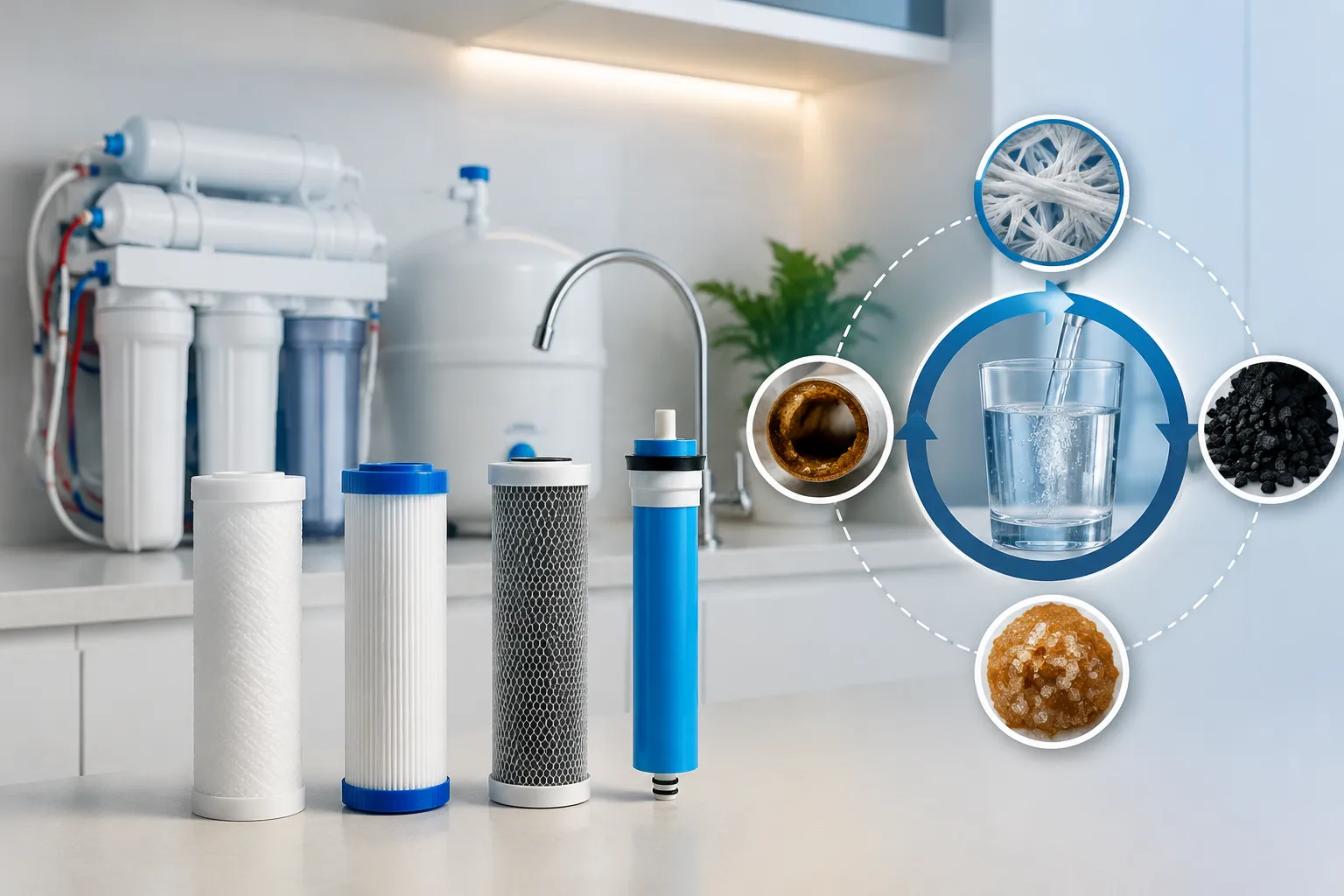
How Often Should You Replace RO Water Filter Cartridges?

arancia
July 22, 2026 • 12 min read
RO water filter replacement follows a clear schedule: sediment and carbon pre-filters every 6–12 months, post-carbon and polishing filters every 12 months, and the RO membrane every 2–3 years. Miss these windows and your membrane — the most expensive component — starts taking on chlorine damage that shortens its life from years to months.
Most households focus only on “does the water taste okay?” That’s too late. By the time taste degrades noticeably, the carbon filter has already been exhausted long enough to let chlorine through to the membrane. The real cost of skipping a $15 filter cartridge can be a $60–$100 membrane replacement six months earlier than necessary.
This guide breaks down the replacement schedule for each filter stage, explains what actually happens when you delay, and shows you how to read the early warning signs — so you get the most from your system without guessing.
RO Filter Replacement Schedule at a Glance
| Filter Stage | Typical Interval | Replace Based On |
|---|---|---|
| Sediment filter (PP cotton) | Every 6–12 months | Time or visible discoloration |
| Carbon pre-filter (CTO/GAC) | Every 6–12 months | Time or taste/odor change |
| RO membrane | Every 2–3 years | TDS reading rise or flow drop |
| Post-carbon / polishing filter | Every 12 months | Time or taste change |
| Remineralization filter | Every 6–12 months | Time or mineral taste decline |
Key rule: Replace pre-filters on schedule even if the water seems fine. They protect your membrane — not just your taste buds.
Why Each Filter Stage Has a Different Lifespan
Sediment Filter: The First Line of Defense
The sediment filter captures particles down to 5–20 microns — sand, rust flakes, and silt — before water reaches any other stage. When it clogs, flow pressure drops across the whole system and those particles get pushed downstream toward the carbon and membrane stages.
Replacement is typically needed every 6–12 months, but this interval shortens fast in areas with older municipal pipes, high turbidity, or well water. A practical trigger: if you have a transparent housing, visible dark discoloration through the casing means the filter is overdue. Don’t wait for pressure to drop noticeably — by then it’s already affecting membrane performance.
Carbon Pre-Filter: The Membrane’s Bodyguard
The carbon pre-filter removes chlorine and chloramines, and adsorbs organic compounds causing taste and odor problems. Of these, chlorine removal is the critical function — standard thin-film composite (TFC) RO membranes have near-zero tolerance for free chlorine. Exposure degrades the membrane polymer irreversibly, and this damage accumulates with every liter that passes through an exhausted carbon stage.
Carbon block capacity is typically rated at 2,000–3,000 gallons or 6–12 months, whichever comes first. At an average household consumption of 2–3 gallons of filtered water per day, 6 months is the safe outer limit for most families. If your source water is heavily chlorinated — common in US municipal supply — err toward the 6-month end.
The mistake many users make: carbon filters show no visual wear. The only indicators are taste and odor changes, which appear after the carbon is already saturated. Time-based replacement is safer than symptom-based replacement for this stage.
RO Membrane: The Core Component
The RO membrane is a semi-permeable barrier rated to filter contaminants down to approximately 0.0001 microns, blocking dissolved salts, heavy metals, PFAS, nitrates, and microplastics. Its rated lifespan is typically 2–3 years under normal residential use — but this assumes pre-filters are changed on schedule.
The most reliable way to monitor membrane health is a TDS (Total Dissolved Solids) meter. Measure TDS before the membrane (feed water) and after (permeate). A well-functioning membrane typically achieves 90–97% TDS rejection. When rejection drops below 85% and stays there despite fresh pre-filters, the membrane has reached end-of-life. Rising TDS in your filtered water is the signal to act — don’t wait for taste changes, which lag behind TDS rises by weeks.
Hard water accelerates membrane scaling. In areas with hardness above roughly 200 mg/L, expect to replace closer to the 2-year mark rather than 3.
Post-Carbon and Polishing Filter
The post-carbon filter sits after the membrane and before your tap. Its job is “polishing” — removing any residual taste or odor that stored water picks up from the system’s internal components. It doesn’t face the same contaminant load as the pre-filter, so 12 months is a reasonable interval for most households.
Skipping this filter won’t damage your membrane, but it will affect the taste of your final output — which is the one thing your household notices immediately.
What Happens If You Skip RO Water Filter Replacement
The Carbon-to-Membrane Cost Cascade
The cost sequence works like this: an expired carbon pre-filter ($10–20) lets chlorine reach the membrane → the membrane degrades faster than its rated lifespan → you replace the membrane ($60–100) 12–18 months early. Skipping a $15 filter replacement routinely costs $80–100 in accelerated membrane wear.
Beyond cost, a degraded membrane allows higher concentrations of dissolved solids, heavy metals, and other contaminants through to your drinking water. TDS rejection dropping to 70% means your “filtered” water may contain significantly more dissolved contaminants than you realize.
How Sediment Clogging Reduces System Pressure
An overloaded sediment filter creates back-pressure across the entire system, reducing the flow rate at your tap and forcing the pump (in electric systems) to work harder. In countertop RO units without a dedicated pump, this can drop output to a trickle before the filter shows obvious discoloration — making time-based replacement especially important.
Special Considerations for Countertop RO Systems
Why Countertop Units Have Shorter Filter Windows
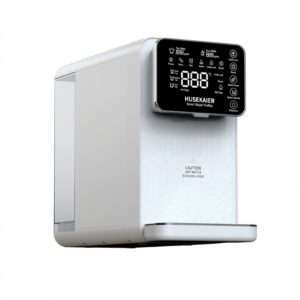
Countertop RO purifiers — such as the Watpur RO Water Purifier — typically run a 3-stage filtration path: PP cotton sediment → activated carbon block → RO membrane. Because these compact units process water on demand without a storage tank, the membrane and pre-filters see the full incoming water volume directly. Practical intervals for countertop systems are:
- PP sediment filter: often 3–6 months in practice, depending on source water quality
- Carbon block: typically 6 months at average household use
- RO membrane: generally 12–18 months in countertop configurations, compared to 2–3 years in larger under-sink systems
The shorter intervals reflect compact filter cartridge size, not lower filtration quality. If your countertop system has a filter life indicator or TDS display, use it as your primary signal rather than relying on calendar scheduling alone.
No Storage Tank Means No Tank Sanitization Concerns
Traditional under-sink systems with a pressurized storage tank need that tank drained every two weeks and sanitized roughly every two years to prevent bacterial buildup. Tankless countertop units produce water on demand, eliminating this concern entirely — one of their genuine practical advantages over conventional RO setups.
5 Signs Your RO Filters Need Replacing Now
Using Symptoms as a Secondary Check
Even with a consistent schedule, certain symptoms mean replace immediately regardless of calendar timing:
- Noticeably slower flow rate — sediment filter or membrane nearing blockage
- Chlorine or metallic taste returning — carbon pre-filter exhausted
- TDS rejection dropping below 85% — membrane approaching end-of-life
- Water appears slightly cloudy — sediment filter breakthrough
- Unusual odor from filtered water — post-carbon filter saturated
How to Track Filter Health Between Changes
A TDS meter ($10–15) is the single most useful maintenance tool for any RO system. Test filtered water monthly and track the trend over time. A sudden upward spike — not gradual drift — usually indicates a pre-filter failure or membrane puncture rather than normal wear. This is particularly useful for catching problems between scheduled replacement dates before they affect water quality significantly.
Conclusion
Staying on top of ro water filter replacement protects the most expensive component in your system. Replace sediment and carbon filters every 6–12 months, your post-carbon filter annually, and your RO membrane every 2–3 years (or 12–18 months for countertop systems). Use a TDS meter to track membrane health rather than guessing from taste alone. A consistent schedule is the difference between a system that runs well for years and one that costs far more than it should.
FAQ
Q1:How often should I replace the RO membrane?
The RO membrane typically lasts 2–3 years in standard under-sink systems, or roughly 12–18 months in compact countertop RO units. The most accurate signal is a TDS rejection drop below 85% — measure with a TDS meter rather than waiting for taste changes, which lag behind actual performance decline by several weeks.
Q2:Can I wait longer than 12 months before replacing pre-filters?
This is a common mistake with real consequences. Carbon pre-filters show no visual wear, but once saturated they allow chlorine to reach the RO membrane. Chlorine degrades the thin-film membrane irreversibly and cumulatively — extending the pre-filter to 18 months to save $15 can result in needing a $60–$100 membrane replacement months earlier than necessary.
Q3:What does a TDS meter tell me about my RO filter condition?
A TDS meter measures total dissolved solids in parts per million (ppm) before and after the RO membrane. Divide permeate TDS by feed TDS and subtract from 1 to get the rejection rate. A healthy membrane typically shows 90–97% rejection. When rejection drops consistently below 85% despite fresh pre-filters, it’s time to replace the membrane. Test monthly and track the trend.
Q4:Is countertop RO filter replacement different from under-sink systems?
Yes. Countertop RO units use smaller filter cartridges and process water directly without a storage tank, which means pre-filters — especially the PP sediment and carbon block — often need replacing every 3–6 months rather than every 6–12 months. If your unit has a built-in filter life display, that reading takes priority over calendar scheduling.
Q5:How much does RO filter replacement cost per year?
For most residential systems, annual filter replacement costs typically range from $30–80 for the pre-filter and post-filter set. The RO membrane, replaced every 2–3 years, generally adds another $40–100 amortized annually. Countertop systems with proprietary filter cartridges may differ — check your specific model’s replacement cartridge pricing for an accurate annual estimate.