RO Water Purifier for Large Family: How to Calculate the Capacity You Actually Need

arancia
July 6, 2026 • 13 min read
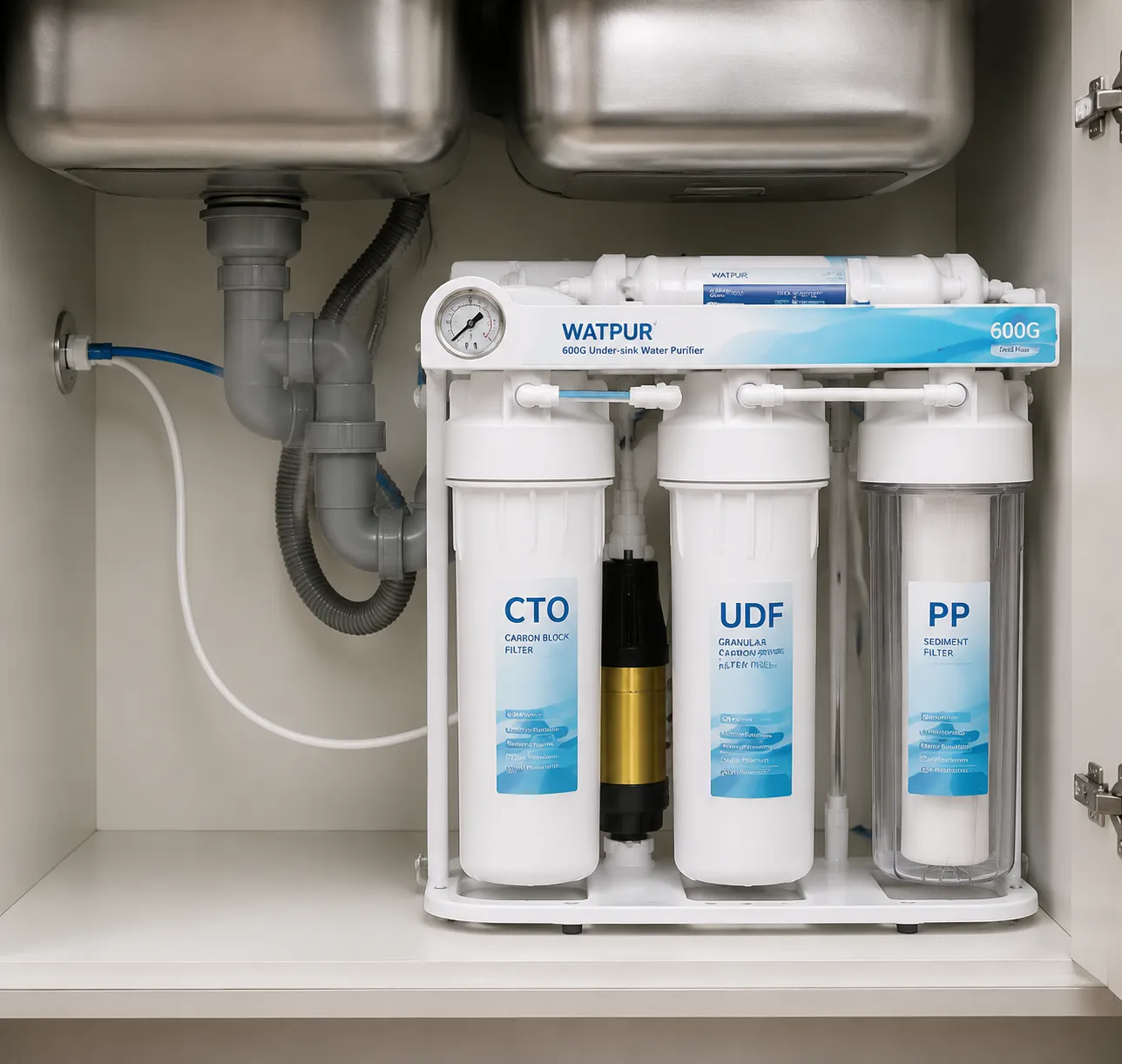
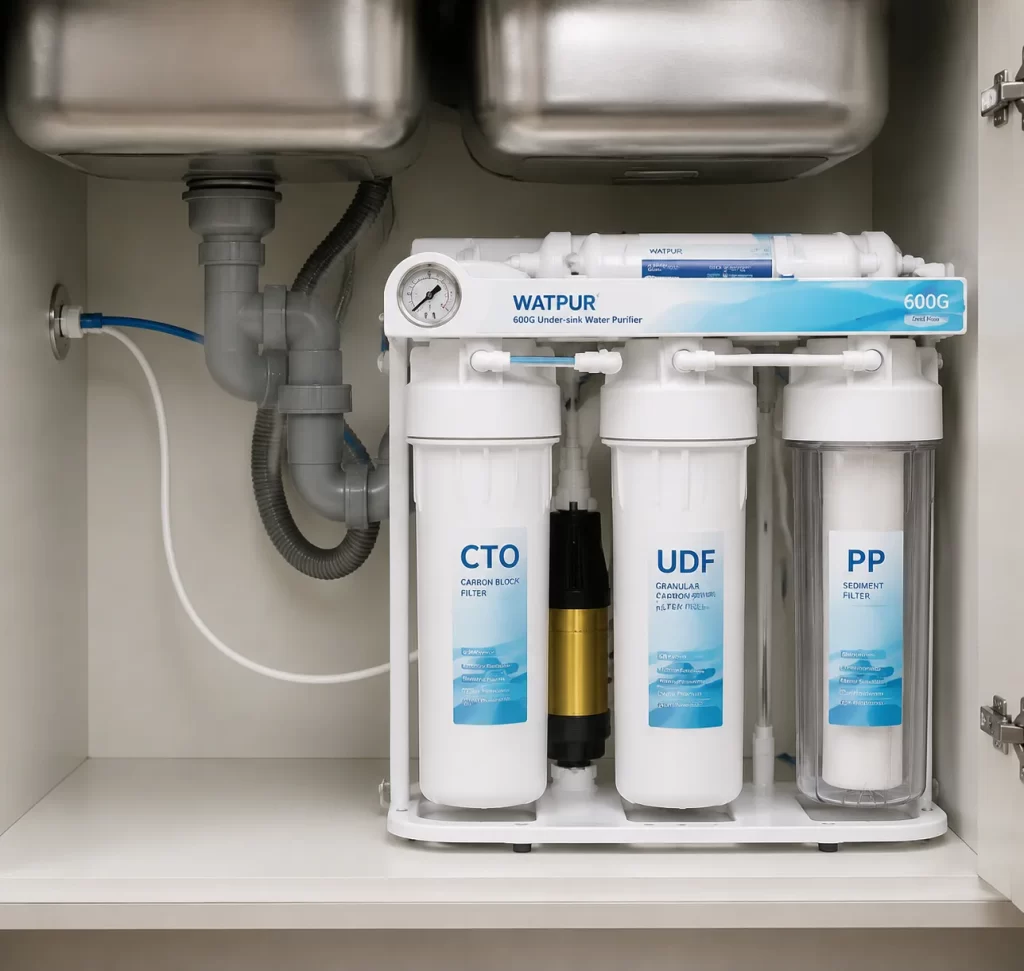
Choosing the right RO water purifier for large family use comes down to one number most product pages skip: your household’s actual daily demand. For a family of five or more, the Watpur 600G (~760 liters/day rated output) is the right starting point — not because you’ll use anywhere near that volume, but because large families hit peak-hour demand that undersized models handle badly. A family of three to four typically does fine with the 400G (~570 L/day).
The mistake most buyers make isn’t choosing the wrong brand — it’s guessing capacity from headcount alone without running the numbers. This guide shows you how to calculate your real daily demand in three steps, explains why peak-hour flow matters more than daily volume totals, and gives you a clear framework for deciding between the 400G and 600G.
→ See the Watpur RO Water Purifier — 400G and 600G available
Step 1: Calculate How Much Water Your Large Family Actually Needs
The Daily Demand Formula for a Large Family
Every RO water purifier for large family listings quotes GPD capacity. Almost none show you how to verify whether that capacity fits your household. Here’s the method:
Start with drinking water: 2–3 liters per person per day. For five adults, that’s 10–15 liters. Add cooking use — soups, rice, pasta, coffee — typically 5–10 liters per day for a household cooking daily. If you prepare infant formula, add 1–2 liters per day. Include a buffer of 5 liters for guests, pets, and high-demand days.
Worked example — family of five:
| Use | Daily Volume |
|---|---|
| Drinking (5 × 2.5 L) | 12.5 L |
| Cooking | 8 L |
| Infant formula | 2 L |
| Buffer | 5 L |
| Total | ~27–30 L |
The Watpur 600G produces approximately 760 liters per day under rated conditions. Your family’s 30 liters is under 4% of that. You will not run out of daily volume — the real question is whether the system keeps up during your peak-demand window.
Why the Morning Rush Matters More Than the Daily Total
Daily volume totals create a false sense of security when choosing an RO water purifier for large family homes. The real test is the 20–30 minute morning window: someone fills a bottle before school, another starts the kettle, someone rinses fruit, a child needs water. These demands cluster together, and a lower-output system cannot recover fast enough between consecutive draws.
The gap between the 400G (~570 L/day) and 600G (~760 L/day) is a 33% increase in rated throughput — a noticeably faster faucet stream and quicker pressure recovery between back-to-back uses. According to WHO guidelines on safe household drinking water, consistent access to adequate water volume is as important as filtration quality for household health outcomes. For families where the kitchen faucet sees heavy simultaneous demand, that throughput difference is felt every morning.
Step 2: Identify Your Household’s Peak-Demand Pattern
Two Patterns That Determine the Right RO Water Purifier for Large Family Use
Not every five-person household uses water the same way. Before settling on a model, identify which pattern matches your home.
Spread-out demand — filtered water use is steady through the day: morning coffee, dinner cooking, water bottles filled individually in the afternoon. Demand rarely clusters. For this pattern, a 400G handles a family of five without issue — the system has time to recover between draws.
Clustered demand — multiple people draw water in the same short window: school-day mornings, post-workout refills, family mealtimes where cooking and drinking happen simultaneously. This is the pattern where the right RO water purifier for large family households is definitively the 600G. The higher rated output keeps pressure consistent even under rapid consecutive use.
A practical test: think about your household’s busiest 15 minutes at the kitchen faucet on a typical day. If more than two people draw water in that window regularly, choose the 600G.
Step 3: Match Your Scenario to the Right Model
When the 400G Is the Right RO Water Purifier for a Large Family of Four
The 400G (~570 L/day) handles a family of three to four on standard municipal water without compromise. It also works well for a family of five with spread-out demand, no infant formula, and moderate cooking use. At $40–$60 less than the 600G, the saving is real when the capacity genuinely fits your pattern.
Choose the 400G if your household has no back-to-back peak demand, uses filtered water mainly for drinking rather than daily high-volume cooking, and has no members — infants, elderly, pregnant — whose needs push total daily volume above 25 liters.
When the 600G Is the Right RO Water Purifier for Large Family Homes
The 600G is the right default for households of five or more, and the right upgrade for families of four that match any of the following:
- Daily cooking at scale — soups, rice, pasta prepared regularly can push cooking use to 8–12 liters per day
- Infant formula preparation — infants need consistent access to purified water; running the system near its recovery limit creates gaps at the worst moments
- Back-to-back peak-hour use — multiple people drawing water within 15 minutes most mornings
- Light commercial or home office use — a small café, clinic waiting area, or office kitchen serving 8–12 people
- Planned household growth — adding a family member within 12–24 months makes the 600G’s headroom worthwhile now
The One Scenario Where the 600G Is Overkill
A family of four that uses filtered water only for drinking — no cooking use, no infant formula, no clustered demand, individual draws spread through the day — does not need 600G capacity. The 400G is the smarter purchase: correctly sized, lower energy draw, lower upfront cost, with no functional difference in day-to-day experience.
Higher GPD does not mean better-filtered water. Filtration quality is determined by membrane specification, not throughput rating. The 400G and 600G Watpur models use the same RO membrane and achieve the same up-to-98% TDS removal — the difference is flow speed only.
UV Upgrade: Who Needs It in a Large Family Home
High-Vulnerability Members Change the Calculation
Large households often include members whose immune systems need extra protection — infants, pregnant women, elderly members, or anyone with a compromised immune system. For these households, the optional Stage 7 UV sterilizer is a meaningful addition regardless of which capacity model you choose.
UV sterilization achieves a 99.9% pathogen kill rate by targeting biological contamination after the RO membrane. NSF International notes that UV treatment is recognized as an effective supplementary layer for biological protection in residential water systems. For a household without high-vulnerability members on clean municipal water, the 5-stage RO system alone provides strong protection. For a large family with mixed age groups, adding Stage 7 at checkout is the right call.
For a full breakdown of what each filtration stage does, see the Watpur 7-Stage Filtration Guide.
Conclusion
The right RO water purifier for large family use is not determined by brand or marketing — it’s determined by your household’s real daily demand and peak-hour pattern. Run the calculation above, identify whether your demand clusters or spreads, and match the result to the 400G or 600G accordingly.
Three steps before ordering:
- Run the demand calculation. Drinking + cooking + formula + buffer. If your total is above 25 liters per day with clustered peak use, choose the 600G.
- Test your tap water TDS. Above 300 ppm confirms you need RO-level filtration. A basic TDS meter costs under $15 and takes 30 seconds to use.
- Decide on UV. If anyone in your household is in a high-vulnerability group — infant, pregnant, elderly — add Stage 7 at checkout.
→ View the Watpur RO Water Purifier — 400G and 600G models
FAQ
Q1: How much filtered water does an RO water purifier for large family use actually need to produce?
A five-person household typically needs 25–35 liters per day for drinking and cooking combined. Even at 35 liters, this is under 5% of the Watpur 600G’s rated daily output — daily volume is never the bottleneck. The real constraint is peak-hour flow rate during the morning rush, which is why throughput rating matters more than the daily volume number when sizing an RO water purifier for large family homes.
Q2: Is the 400G genuinely enough for a family of 4?
Yes, for most families of four on standard municipal water. The 400G produces approximately 570 liters per day — roughly 15–20 times a typical four-person household’s daily filtered water demand. It handles back-to-back use well unless demand is consistently clustered across multiple simultaneous users. The 400G is insufficient only when a family of four combines high cooking use, infant formula preparation, and peak-hour clustered demand on most days.
Q3: Does buying a higher GPD model give cleaner water?
No. GPD rating determines flow speed and throughput, not filtration quality. The Watpur 400G and 600G use the same RO membrane specification and achieve the same up-to-98% TDS removal rate. A higher GPD model fills a glass or cooking pot faster and recovers pressure more quickly between consecutive draws — it does not produce more thoroughly filtered water. Choose capacity based on your household’s demand pattern, not on the assumption that higher output means better purification.
Q4: Can an RO water purifier for large family use handle light commercial demand?
The Watpur 600G (~760 L/day rated output) is suitable for light commercial applications: a small café serving 20–30 customers per day, a clinic waiting area, or an office kitchen for 8–12 people. For heavier commercial demand — restaurants, large offices, continuous-service environments — a commercial-grade system with a higher rated output and commercial-spec membrane is the appropriate solution. Contact Watpur directly for commercial requirements.
Q5: How do I know if my water quality actually requires RO filtration?
Test your tap water TDS with an inexpensive handheld meter (under $15). A reading consistently above 300 ppm — common in hard water areas, well water, and many municipal supplies in the US Southwest and Midwest — confirms that RO-level filtration is warranted. Below 150 ppm on well-managed municipal water, a high-quality carbon block filter may achieve comparable results at lower cost. Between 150–300 ppm is a judgment call based on specific contaminants. For guidance on interpreting TDS readings in the context of local water quality, the EPA’s drinking water standards are a useful reference.