What Is TDS in Water — and When Does It Actually Matter?

arancia
July 10, 2026 • 16 min read
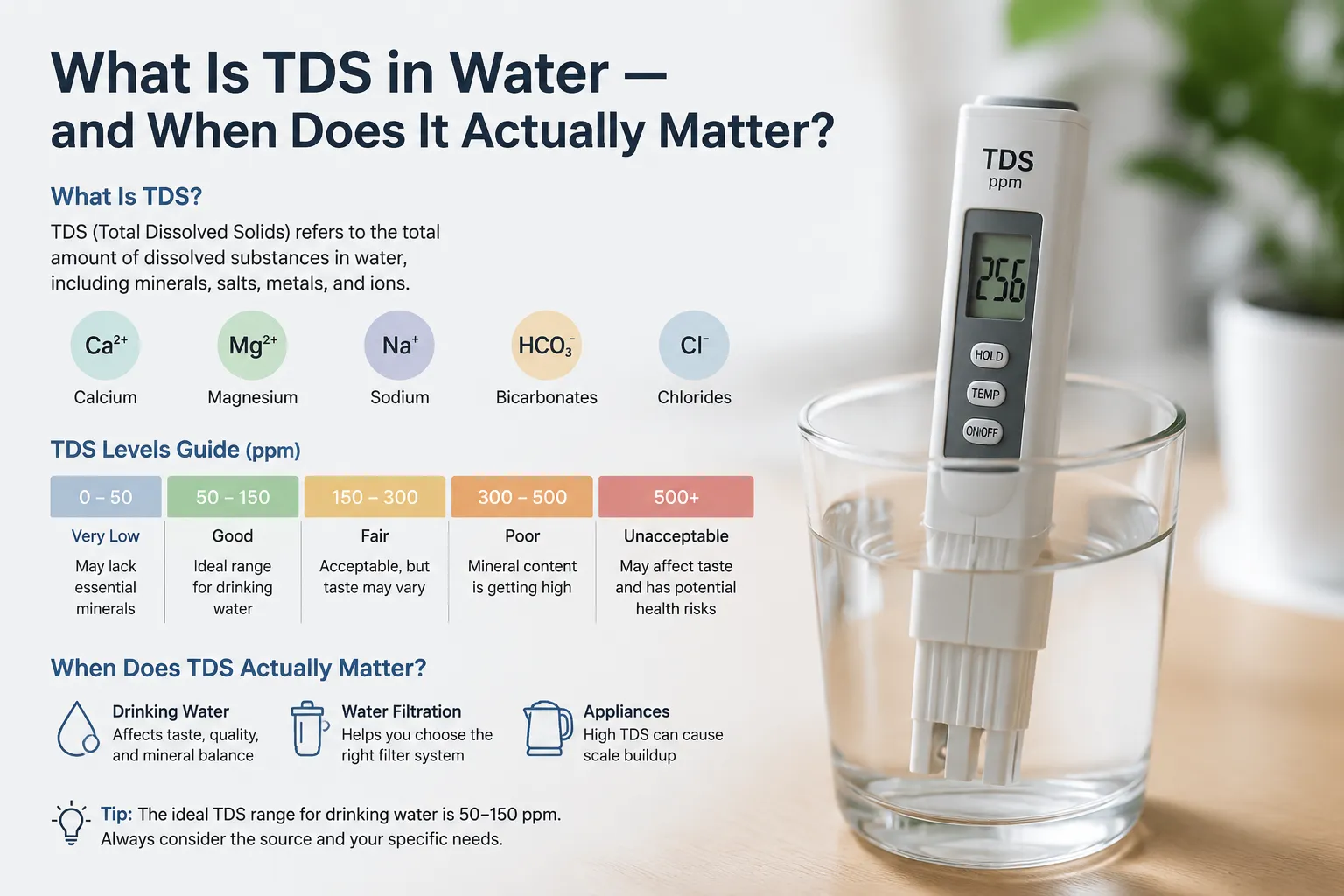
TDS stands for Total Dissolved Solids — a measure of everything dissolved in water that isn’t an H₂O molecule, expressed in parts per million (ppm) or milligrams per liter (mg/L). A TDS meter tells you how much is dissolved in your water; it cannot tell you what those substances are. That distinction is the single most important thing to understand about TDS, because it determines whether a high reading is cause for action or simply a feature of your local geology.
Most people encounter TDS in one of two situations: they’ve bought a cheap TDS meter online and their tap water reads 350 ppm, or they’ve just installed a water filter and are trying to verify it’s working. In both cases, the number alone doesn’t tell you what you actually need to know. This guide explains what TDS measures, what the standard reference ranges mean, the four situations where a high TDS reading genuinely matters — and the three situations where it doesn’t.
What TDS Actually Measures — and What It Doesn’t
TDS is a single number that represents the combined concentration of all dissolved inorganic and organic substances in water — minerals, salts, metals, and trace compounds — that are small enough to pass through a 2-micrometer filter.
What Goes Into a TDS Reading
The substances that contribute to TDS fall into two fundamentally different categories, and conflating them is the source of most TDS confusion.
Naturally occurring minerals — calcium, magnesium, potassium, sodium, bicarbonates, sulfates — make up the majority of TDS in most municipal and well water supplies. These enter water as it moves through soil and rock formations over years or decades. A spring water reading of 300 ppm is almost entirely minerals. Many bottled mineral waters sold at a premium contain 200–500 ppm TDS specifically because of their mineral content.
Anthropogenic contaminants — lead from corroding service lines, nitrates from agricultural runoff, arsenic from industrial discharge, PFAS compounds from manufacturing sites — also dissolve into water and contribute to TDS readings. At dangerous concentrations, these can appear in water with TDS readings anywhere from 50 ppm to 800 ppm.
The critical limitation: a TDS meter cannot distinguish between these two categories. A reading of 400 ppm could be 395 ppm calcium and magnesium plus trace lead — or it could be 200 ppm minerals plus elevated nitrates and arsenic. The number is identical. The health implications are completely different.
Why TDS Became a Proxy for Water Quality
TDS became a popular consumer metric partly because TDS meters are inexpensive (typically $10–$20) and give an instant reading, and partly because it is a real parameter in drinking water guidelines. The EPA’s secondary drinking water regulations advise a maximum TDS level of 500 ppm for public drinking water — though this is classified as a secondary standard, meaning it addresses taste, odor, and aesthetic effects rather than direct health risk. Both the EPA and the Canadian drinking water guidelines maintain aesthetic limits on TDS levels — they don’t set primary standards for TDS, which generally means the substance in question isn’t a significant risk to health at these levels.
The WHO conducted a study on TDS taste preferences and found that most people find water with under 300 ppm most palatable, with satisfaction declining above 600 ppm — but this is a palatability classification, not a safety threshold.
TDS Reference Ranges: What the Numbers Mean in Practice
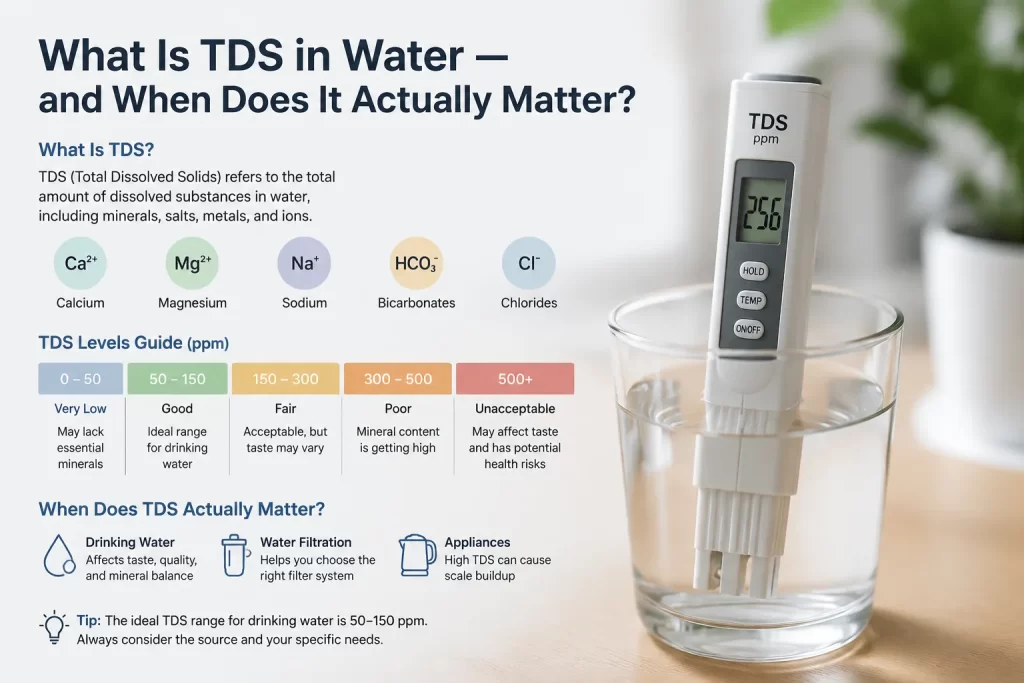
These ranges represent consensus across EPA, WHO, and Water Quality Association guidelines. They are reference points, not hard safety cutoffs — and they apply to TDS as a whole, not to any individual substance within it.
| TDS Level (ppm) | What It Typically Indicates | Taste Profile |
|---|---|---|
| 0–50 | Extremely low; RO or distilled water | Flat, “empty” — lacks mineral character |
| 50–150 | Low mineral content; many filtered waters | Clean, neutral |
| 150–300 | Moderate minerals; typical good municipal water | Slightly mineral, pleasant to most |
| 300–500 | Higher mineral content or moderate dissolved load | May taste slightly bitter or salty |
| 500–1,000 | Above EPA aesthetic guideline | Noticeably off-taste; scale buildup likely |
| 1,000+ | High; WHO considers unacceptable for drinking | Strong off-taste; filtration recommended |
The WHO considers water above 1,000 mg/L unacceptable, and palatability decreases above 600 mg/L. These thresholds exist because at high TDS concentrations, even benign dissolved minerals start affecting taste, appliance longevity, and pipe scaling — independent of any health concern.
When High TDS Actually Matters
High TDS is worth acting on in four specific situations. In each case, the concern is not the TDS number itself but what the number signals about the specific dissolved substances likely to be present.
When Your Water Source Is a Private Well
Private wells are not subject to municipal treatment standards or EPA monitoring requirements. The EPA only regulates municipal water, so if you own a private well, it’s your responsibility to reduce TDS to a safe concentration. Agricultural areas near fertilizer use carry elevated nitrate risk; areas near mining or industrial sites carry heavy metal risk; older rural properties may have naturally occurring arsenic or manganese. A high TDS reading from a private well is a stronger signal to test further than the same reading from treated municipal water — because there’s no treatment system upstream checking the individual contaminants.
If your well water reads above 300 ppm, the appropriate response is a certified laboratory water test, not just a TDS meter reading. A lab panel ($30–$100 depending on parameters) will tell you exactly what’s contributing to that number.
When Your Building Has Older Plumbing
In buildings constructed before 1986 in the US — when lead pipe use was formally banned — service lines, solder joints, or fixtures may contain lead. Lead dissolves into water that sits in pipes and contributes to TDS readings, but the amounts involved are small enough that they may not significantly move a TDS meter reading. A building where the overall TDS reads 250 ppm could still have lead concentrations well above the EPA action level of 15 parts per billion. This is a case where TDS provides no reliable safety signal at all — only a certified lead test does.
The practical rule: if your building predates 1986, test specifically for lead regardless of your TDS reading.
When TDS Is Above 500 ppm on Municipal Water
Municipal water above 500 ppm consistently indicates either high natural mineral content or inadequate treatment — and at this level, the aesthetic effects are real: scale buildup on appliances, shortened water heater life, soap that lathers poorly, and water that tastes noticeably bitter or salty. Water that contains high levels of dissolved calcium and magnesium can result in high TDS levels; when these salts dissolve, they collect in pipes and form scale buildup, which can result in costly pipe replacements and shorten the lives of appliances.
Above 500 ppm, filtration to reduce TDS is justified on purely practical grounds — appliance protection and taste — regardless of what specific substances are present.
When You’re Monitoring an Existing Filter’s Performance
This is the one context where TDS meters are genuinely useful as a standalone tool. A functioning RO membrane should reduce tap water TDS by 90–98%. If your filtered output reads 20 ppm against a tap reading of 300 ppm, the membrane is working. If that gap narrows significantly over time — say, filtered output climbs to 80 ppm against the same source water — the membrane is degrading and needs replacement. If you use a reverse osmosis unit, you can calculate the TDS rejection percentage with the formula: TDS % Rejection = (Tap Water TDS – RO Water TDS) ÷ Tap Water TDS × 100. A rejection rate that drops below 85% is a reliable indicator that maintenance is due.
When High TDS Doesn’t Actually Matter
When You’re on Treated Municipal Water Under 500 ppm
Treated municipal water in the 150–500 ppm range has already passed EPA-regulated testing for individual health-relevant contaminants — lead, nitrates, arsenic, bacteria — independently of its TDS reading. A reading of 350 ppm from a city supply is overwhelmingly likely to be minerals and treatment byproducts rather than hazardous substances. TDS isn’t generally a health concern in drinking water — a high TDS level can impact water’s taste and the efficiency of water-using appliances, but many dissolved solids are generally not harmful to drink. If your water tastes fine and you have no specific reason to suspect contamination, a 350 ppm reading on municipal water requires no action.
When TDS Is Very Low
There is no scientific data to prove that drinking water with low TDS will have adverse health effects — low TDS means the water quality is excellent, but it tends to have a flat taste. However, some research suggests that water stripped of all minerals — TDS below 25–50 ppm from distillation or aggressive RO — may leach trace minerals from the body over time with very high daily consumption. For most people drinking a varied diet, this is not a material concern. But it does explain why premium filtered water systems increasingly include a mineral reintroduction stage: the goal is not zero TDS but an optimal range, typically 50–150 ppm.
When You’re Comparing Bottled Water to Tap
Bottled mineral water often has TDS of 200–700 ppm — intentionally, because the mineral content is part of the product’s identity and taste profile. Tap water at 250 ppm is not less safe than bottled water at 250 ppm. TDS parity between tap and bottled doesn’t indicate equivalent safety or quality; it indicates similar dissolved solid concentrations, which could come from entirely different sources and compositions.
How to Actually Test Your Water If TDS Raises a Concern
A TDS meter is a useful starting point and a good filter monitoring tool. It is not a water safety test. Here is the appropriate sequence:
Step 1 — TDS meter: Establish your baseline reading and identify whether further investigation is warranted. Above 500 ppm or a sudden unexplained increase both warrant follow-up.
Step 2 — Local water quality report: Municipal suppliers in the US are legally required to publish annual Consumer Confidence Reports listing individual contaminant levels. Search “water quality report” or request one from your utility directly. This tells you what’s actually in your water beyond the TDS number.
Step 3 — Certified laboratory test: For well water, older buildings, or any specific contaminant concern, a lab panel is the only way to get individual substance concentrations. Look for labs certified by your state’s environmental agency or NSF International. Test panels can be targeted — lead-specific, nitrate-specific, or comprehensive — depending on your concern.
Step 4 — Act on what the test shows, not on TDS alone: If lead is detected above 15 ppb, an NSF/ANSI 53-certified filter or RO system addresses it. If nitrates exceed 10 ppm, RO is the appropriate solution — boiling concentrates nitrates rather than removing them. If the concern is purely mineral hardness and scale, a water softener targets hardness without the full contaminant removal of RO.
Conclusion
TDS in water is a useful measurement with a specific, limited meaning: it tells you how much is dissolved in your water, not what. A high TDS reading is a reason to investigate further — particularly if you’re on a private well, have an older building, or see readings consistently above 500 ppm. It is not, by itself, evidence that your water is unsafe. The most common mistake with TDS meters is treating the number as a pass/fail safety result. It isn’t. Used correctly — as a filter monitoring tool and an initial screening signal — TDS is genuinely useful. Used as a substitute for actual water testing, it can produce either false reassurance or unnecessary alarm, depending on which direction the number points.
If your TDS reading concerns you, the right next step is your local water quality report, not a new filter. Start with information, then decide whether action is needed.
FAQ
Q1: Is 400 ppm TDS safe to drink?
It depends entirely on what’s contributing to that 400 ppm. If you’re on treated municipal water, 400 ppm is above the EPA’s aesthetic guideline of 500 ppm but likely composed mostly of minerals — not a health hazard, though you may notice taste effects. If you’re on a private well, 400 ppm warrants a full laboratory test to identify the individual substances present. The number alone cannot answer the safety question.
Q2: Does a TDS meter tell me if my water has lead?
No. Lead can be present at dangerous concentrations — above the EPA action level of 15 parts per billion — without meaningfully changing a TDS reading. A TDS meter measures total dissolved load; lead at hazardous levels is measured in parts per billion, which is too small to register on a parts-per-million TDS scale. The only way to test for lead is a certified laboratory test or a lead-specific test kit.
Q3: What TDS level should filtered water be after an RO system?
A well-functioning RO system should reduce source water TDS by 90–98%. If your tap water reads 300 ppm, filtered output should be in the 6–30 ppm range. The absolute number matters less than the rejection percentage — consistent output in the 50–150 ppm range from a source above 400 ppm would suggest the membrane needs attention. Track the rejection rate over time rather than fixating on the output number alone.
Q4: Can water TDS be too low?
At TDS below 25–50 ppm — typical of distilled water or aggressively filtered water — the water tastes flat and some researchers suggest high daily consumption of very low TDS water may gradually affect electrolyte balance in active individuals. For most people eating a normal diet, this is not a significant concern. If you find filtered water tastes flat, a mineral reintroduction stage that brings output up to 50–100 ppm typically resolves it without reintroducing contaminants.
Q5: Why does my TDS reading go up right after installing a new carbon filter?
Fresh activated carbon — particularly coal-based carbon with ash content above 3% — can temporarily leach minerals during the first few liters of use, briefly raising TDS readings above the source water level. This is normal and resolves within a few gallons of flushing. It is one reason coconut shell carbon with lower ash content is preferred in drinking water applications: it produces more stable TDS readings from installation without an initial mineral-leaching phase.