What Is a 7-Stage RO Water Purifier? How Each Filter Stage Works

arancia
July 4, 2026 • 16 min read
A 7-stage reverse osmosis (RO) water purifier removes up to 98% of dissolved contaminants — including lead, fluoride, nitrates, chlorine byproducts, and PFAS — by passing tap water through a sequential series of mechanical, chemical, and membrane filtration stages. Across the 2026 market, a good-quality tankless home model typically costs $280–$600 upfront, with annual filter maintenance running $80–$200 — making the three-year total cost of ownership roughly $550–$1,100 for most imported systems. Watpur comes in noticeably below that range while matching the same certification and build standards.
Most families shopping for a home water filtration system run into the same wall: chlorine-smelling tap water, uncertainty about lead in aging pipes, and bottled water bills that keep climbing without any real guarantee of what’s inside the plastic. Standard pitcher filters reduce the smell, but they can’t touch the dissolved heavy metals, nitrates, or bacteria that only an RO system can reliably stop.
This guide explains exactly what each of the 7 filtration stages does, why the sequence matters, what the total cost looks like over three years, and how to match the right output capacity to your household size — so you can make a confident decision before you buy.
How a 7-Stage RO Water Purifier Actually Works
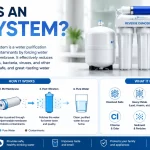
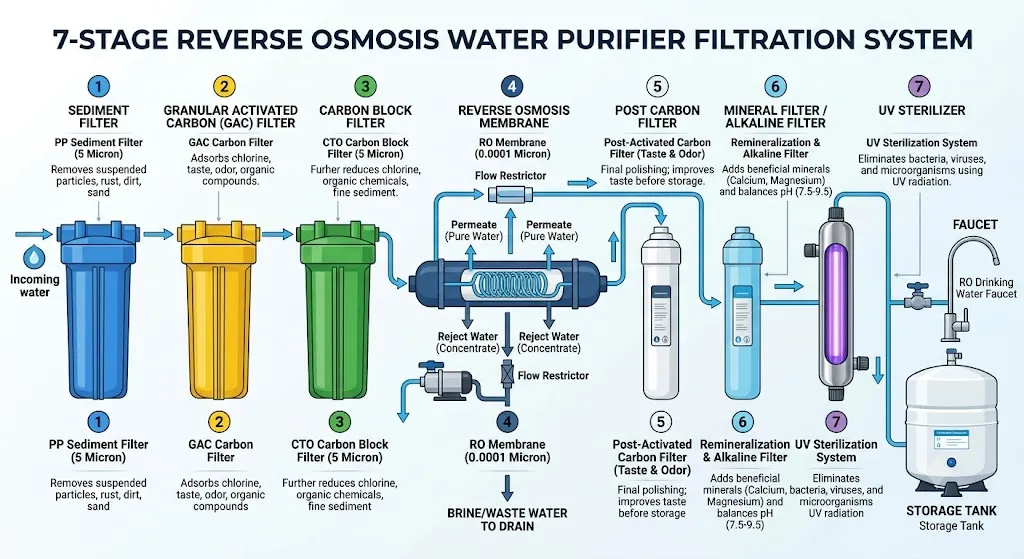
7-stage RO water purifier filtration diagram showing all stages
A 7-stage system is built around one core idea: different contaminants require different removal mechanisms, and no single filter can do everything. The stages are arranged in a deliberate sequence — each one protecting the next, and each one targeting a specific class of problem.
Stages 1–3: Pre-Filtration (The Protective Layer)
The first three stages exist primarily to protect the RO membrane in Stage 4. If sediment, chlorine, or organic compounds reach the membrane unchecked, they degrade it rapidly — cutting its lifespan from 18–24 months down to as little as 6.
Stage 1 — PP Sediment Filter captures rust particles, sand, dust, and suspended solids down to 5 micrometers. Think of it as the bouncer at the door: it stops everything visible (and near-visible) before it causes damage downstream. Most households on municipal water will notice this cartridge turning brown or orange within 3–6 months — that’s the rust and sediment from distribution pipes that would otherwise reach your glass.
Stage 2 — Granular Activated Carbon (GAC) adsorbs free chlorine, chloramines, and the disinfection byproducts that give tap water its characteristic swimming-pool smell. Activated carbon works through an enormous surface area — typically 500–1,500 m² per gram — that chemically attracts and traps organic molecules. Most users notice an immediate improvement in taste and odor after this stage alone.
Stage 3 — Compressed Carbon Block (UDF) provides a denser second pass at chlorine removal. This is critical because even trace chlorine degrades the polyamide material of the RO membrane over time. By the time water exits Stage 3, chlorine concentration is near zero — the membrane’s optimal inlet condition.
Stage 4: The RO Membrane — Where the Real Work Happens
The RO membrane is the core of any reverse osmosis water purifier for home use. At a filtration precision of 0.0001 micrometers — fine enough that only individual water molecules pass through — it rejects dissolved ionic contaminants that no other consumer filter technology can touch.
Under inlet pressure of 0.2–0.4 MPa, water is forced through the semipermeable membrane. Rejected contaminants — lead (Pb²⁺), cadmium, mercury, fluoride, nitrates, dissolved salts, bacteria, pharmaceutical residues, and PFAS compounds — are flushed to drain. The result is a TDS (total dissolved solids) reduction rate of up to 98% under NSF/ANSI 58 test conditions. To put that in practical terms: if your tap water reads 400 ppm on a TDS meter, filtered output will typically measure 8–12 ppm.
The trade-off worth knowing: the RO process uses approximately 2–4 liters of water for every 1 liter of purified output, depending on system design. For most households, this adds roughly $5–$15 to the annual water bill — a figure that’s almost always smaller than the cost of a single month’s bottled water.
Stage 5: Post-Carbon Polish
After the RO membrane, water is chemically clean but can carry trace process odors from the system itself. The post-carbon stage — typically a compact T33 activated carbon block — neutralizes any residual taste or smell before water reaches your glass. This is the difference between water that tests clean and water that actually tastes clean.
Stages 6–7: Optional Upgrades Worth Understanding
Stage 6 — Mineral Ball Filter reintroduces beneficial trace minerals — calcium, magnesium, potassium — that the RO membrane removes along with contaminants. Pure RO water (TDS near zero) has a slightly flat taste; mineral reintroduction at controlled concentrations restores the balanced flavor profile most people associate with good drinking water. This upgrade is particularly recommended for families with young children who drink predominantly filtered water and rely on it as a mineral source.
Stage 7 — UV Sterilizer exposes output water to ultraviolet light at a wavelength that disrupts bacterial and viral DNA, achieving a 99.9% pathogen kill rate without adding any chemicals. Unlike the membrane stage, which blocks bacteria physically, UV deactivates any microorganisms that make it through — including those introduced after filtration. This upgrade is most valuable for households with infants, pregnant women, elderly members, or anyone with a compromised immune system.
Why Tank-Free Design Changes the Safety Equation
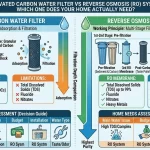
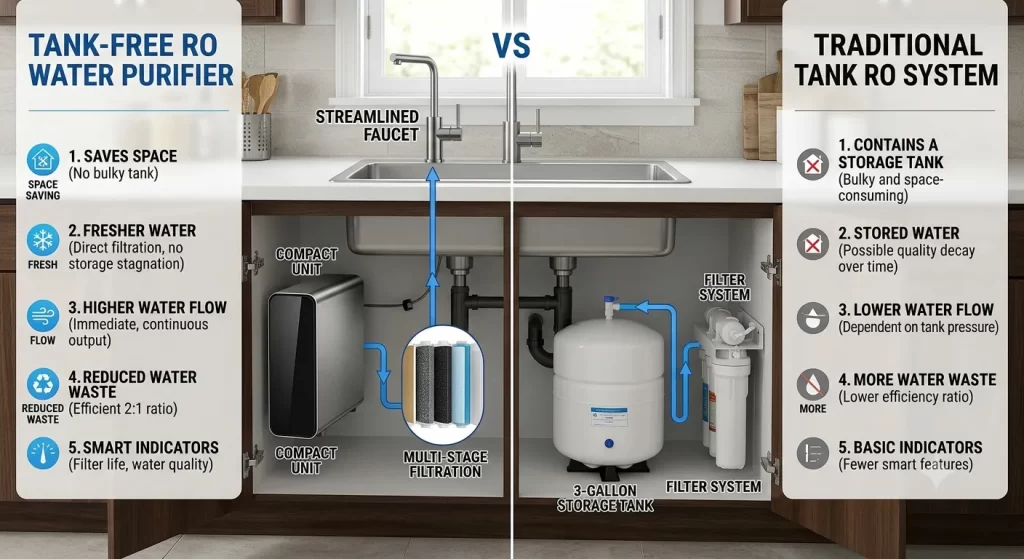 tank-free RO water purifier vs traditional tank RO system comparison
Most conventional RO systems store purified water in a pressurized holding tank. The problem: stagnant filtered water is still a bacterial growth environment, particularly when tanks aren’t flushed regularly. A tank-based system can pass Stage 4’s membrane flawlessly and still deliver contaminated water at the tap if the tank develops biofilm.
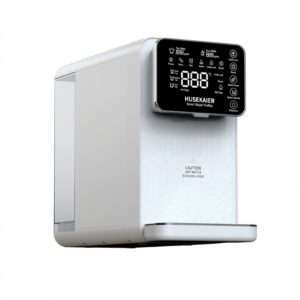
The Watpur RO water purifier eliminates this risk entirely with a tank-free, on-demand design: water is processed at the moment you use it, never stored. It also routes pre-filtered water (Stages 1–3 only) to a secondary outlet for washing vegetables and rinsing dishes — meaning the RO membrane handles only drinking-volume demand, which extends membrane service life significantly compared to systems that route all kitchen water through the membrane.
Certifications and Safety: What to Check Before You Buy
Choosing an RO water purifier for home use without verifying certifications means taking a brand’s word for its own filtration claims. Two certifications matter most for household buyers.
What Certifications Actually Prove
NSF/ANSI 58 is the benchmark standard for residential RO systems in North American markets. It verifies TDS rejection rates and contaminant reduction claims under standardized test conditions — meaning an independent laboratory tested the actual product, not just the membrane spec sheet. When evaluating any RO system, ask for the NSF certificate number and verify it at nsf.org/certified-products. Some manufacturers instead list “tested to NSF/ANSI 58 standards” or an equivalent-certification claim, typically because the product was evaluated by an accredited third-party lab (such as SGS or Intertek) against the same test protocol without going through formal NSF listing. That’s a legitimate alternative as long as the manufacturer can produce the actual lab report — just ask to see it, and confirm the lab is accredited, rather than accepting the claim on the packaging alone.
CCC (China Compulsory Certification) is the mandatory electrical safety standard for products sold in the Chinese market, covering insulation, electromagnetic compatibility, and material safety. For globally distributed systems operating at both 110V and 220V, CCC certification is a meaningful indicator of electrical build quality.
ISO 9001 certifies the manufacturer’s quality management processes — not the product itself, but the consistency of how it’s made. ISO 9001 audits cover production controls, defect prevention, and batch-to-batch consistency: relevant assurance when you’re buying a product you’ll depend on for 3–5 years.
The Watpur RO system holds CCC certification, ISO 9001 quality management certification, and a Chinese health permit (Certificate No.: Yue Wei Shui Zi [2024]-02-S0439) — one of the more demanding regulatory approvals for household water purification in the Chinese market.
How to Verify Before You Buy
If a system claims NSF/ANSI 58 testing without formal NSF listing, ask the seller for the underlying lab report from an accredited third-party lab (such as SGS or Intertek) and confirm the lab’s accreditation independently. For CCC and ISO 9001, request the certificate with issuing body name and expiry date — legitimate certificates are always dated and auditor-identified.
Choosing the Right Capacity: 100G, 400G, or 600G?
The “G” in RO system specifications refers to gallons per day of purified output. Matching capacity to your household’s actual daily water consumption is the single most practical selection decision you’ll make.
| Model | Daily Output | Best For | Power Draw | Watpur Price | Comparable Imported 7-Stage Tankless System |
|---|---|---|---|---|---|
| 100G | ~380 L/day | 1–2 people, studio apartment | Low | ~$179–$209 | ~$230–$300 |
| 400G | ~570 L/day | Family of 3–4 (most popular) | 30W | ~$249–$279 | ~$300–$320 |
| 600G | ~760 L/day | 5+ people or light commercial | Moderate | ~$309–$349 | ~$430–$540 |
Comparable-system figures reflect current retail pricing for equivalent-capacity 7-stage tankless RO units from major imported brands, so the gap widens at higher capacities where imported systems carry a bigger premium for the added pump and flow-rate hardware.
For a family of four on municipal water with moderate TDS (200–400 ppm), the 400G model delivers the best balance of daily output, energy efficiency, and cabinet footprint. The 600G is worth considering if you also use filtered water for cooking, coffee, or baby formula in high volumes.
All three models support wall-mounted, countertop, and under-sink installation, and fit in a 360 × 210 × 450 mm footprint. Most households complete installation independently in under 30 minutes.
What Does a Watpur 7-Stage RO System Actually Cost to Own?
The purchase price is only part of the picture, and it’s also where Watpur has an edge — Watpur is priced below comparable imported 7-stage tankless systems while matching them on certification and build quality. Using the 400G model (the most popular size) as the reference point, here’s what three years of ownership typically looks like:
| Cost Item | Watpur 400G | Comparable Imported Tankless System |
|---|---|---|
| Device purchase | ~$249–$279 | ~$300–$430 |
| Annual filter cost (Stages 1–3, 5) | ~$45–$70/year | ~$80–$150/year |
| RO membrane replacement (every 12–24 months) | ~$25–$40/replacement | ~$50–$150/replacement |
| Water usage increase | ~$5–$15/year | ~$5–$15/year |
| 3-Year TCO (estimate) | ~$430–$590 | ~$650–$1,050 |
For comparison: a family of four drinking 2 liters each per day from bottled water at $1.50 per 1.5L bottle spends roughly $730–$800 per year on water alone — about $2,200 over three years. At Watpur’s price point, the system pays for itself within the first year for most households at typical bottled water consumption rates, and reaches that break-even point faster than most imported equivalents.
Conclusion
A 7-stage RO water purifier is the right investment when your household’s tap water TDS consistently reads above 300 ppm, when you have aging pipe infrastructure introducing heavy metals, or when you have family members — infants, elderly relatives, pregnant women — for whom contaminant exposure carries elevated risk. The Watpur RO system covers all three output sizes, installs in three configurations, undercuts comparable imported systems on price, and eliminates the secondary contamination risk that tank-based systems carry by design.
Three steps before you order:
- Test your tap water TDS. A meter costs under $15 and tells you whether your water quality problem actually requires RO-level filtration.
- Match model to household size. 1–2 people → 100G; family of 3–4 → 400G; 5+ or light commercial → 600G.
- Decide on Stage 6/7 upgrades. Households with infants or immunocompromised members should add the UV sterilizer. Daily high-volume drinkers benefit from the mineral ball.
→ See the Watpur RO Water Purifier and choose your model
FAQ
Q1: How do I know if my home actually needs a 7-stage RO purifier?
Test your tap water TDS with an inexpensive meter (under $15 online). A reading consistently above 300 ppm indicates dissolved solids — heavy metals, salts, nitrates — that carbon-only filters cannot address. For municipal water below 150 ppm with no heavy-metal concerns, a quality carbon block filter may be sufficient. Above 300 ppm, or if your building has older iron or copper pipes, RO is the correct solution.
Q2: How often do I need to replace the filters, and what happens if I forget?
Stages 1–3 and 5 (carbon and sediment filters) should be replaced every 3–6 months depending on local water quality and usage volume. The RO membrane (Stage 4) typically lasts 12–24 months. Skipping filter changes doesn’t just reduce filtration performance — an exhausted carbon filter stops protecting the RO membrane from chlorine, which can degrade membrane performance and shorten its lifespan from 24 months to as little as 6–8. Set a calendar reminder when you install each cartridge.
Q3: Is RO-filtered water safe for making baby formula?
Yes. The RO membrane removes the specific contaminants — lead, nitrates, bacteria, and dissolved heavy metals — that pose the greatest risk to infants. Households preparing formula should consider adding the Stage 7 UV sterilizer for an additional 99.9% pathogen kill rate. At these concentrations, nitrates in particular can interfere with oxygen transport in infants’ blood, so RO filtration is the appropriate water source for formula preparation in areas with elevated nitrate levels.
Q4: What’s the real difference between a 5-stage and 7-stage RO system?
A standard 5-stage system (PP sediment + GAC + UDF + RO membrane + post-carbon) handles the core filtration job: removing dissolved solids, heavy metals, chlorine, and organic compounds. Stages 6 and 7 — mineral reintroduction and UV sterilization — are enhancements, not necessities for most households. The mineral stage improves taste and restores beneficial calcium and magnesium. UV sterilization adds biological safety for higher-risk users. For average households on municipal water, the 5-stage output is safe and clean; for families with infants or elderly members, the full 7-stage configuration provides meaningful additional protection.
Q5: How do I verify that an RO system’s certifications are real?
If a brand is formally NSF-listed, go to nsf.org/certified-products and search the brand name or certificate number — the listing will show exactly which contaminants the system is certified to reduce and under what test conditions. Many manufacturers instead have their systems tested to NSF/ANSI 58 standards by an accredited third-party lab (such as SGS or Intertek) without going through formal NSF listing — in that case, ask the seller directly for the lab report rather than searching the NSF database. For CCC certification (Chinese market), certificate numbers can be verified at the CQC official website. Always ask the seller to provide the actual certificate or lab report, not just a logo or claim on the product page.